
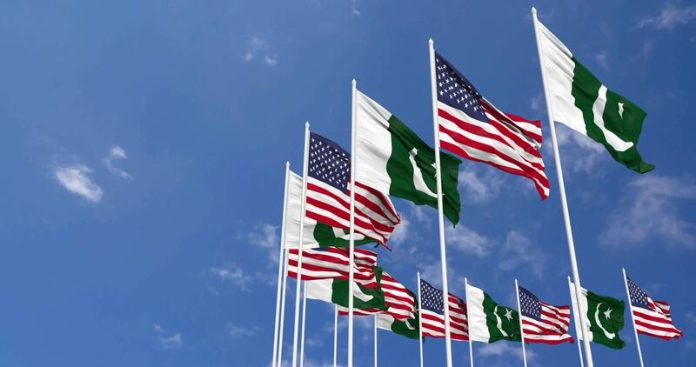

WASHINGTON — The Trump administration has reaffirmed Pakistan’s importance as a partner in South and Central Asia, emphasizing plans to enhance trade, economic cooperation, and security ties between the two countries.
Speaking before the House Foreign Affairs Committee’s Subcommittee on South and Central Asia on Wednesday, Assistant Secretary of State Paul Kapur highlighted Pakistan’s strategic role in the region and outlined growing bilateral collaboration.
“Pakistan is a key partner in the region. We are working together to unlock the potential of its critical mineral resources, combining US government seed funding with private sector expertise, benefiting both nations,” Kapur told the subcommittee. He also pointed out expanding cooperation in energy and agriculture trade.
Kapur underscored continued counter-terrorism collaboration, noting that it helps Pakistan address domestic security threats while mitigating transnational risks that could affect the US or its allies.
During the session, lawmakers questioned Kapur on regional militancy, Pakistan’s previous security policies, and broader South and Central Asian dynamics. A congressman referenced Kapur’s academic work on Pakistan, asking if militant groups from the region were active in the United States.
Kapur clarified that while Pakistani and South/Central Asian militant groups are not operating in the US as organized entities, individual members could be present. He noted that one of the challenges in counter-terrorism is that small numbers of extremists can blend into the general population, making detection difficult.
The discussion then shifted to India’s role in US strategy toward China. When asked about India’s contribution to countering an assertive China, Kapur said a strong, independent India capable of maintaining freedom of action supports US strategic interests. He added that an economically and militarily self-reliant India limits China’s ability to dominate the Indo-Pacific region.
On China’s Belt and Road Initiative, Kapur noted that India’s economic growth and infrastructure development act as a check on Beijing’s expanding influence in the region.
Committee members from both parties emphasized the importance of US engagement in South Asia. Chairman Bill Huizenga stressed the need for a comprehensive and values-driven approach, anchored in strong partnerships, economic ties, and democratic principles.
Democratic members raised concerns over regional crises. Congresswoman Sydney Kamlager-Dove highlighted the May conflict between India and Pakistan, warning of nuclear escalation risks in a region home to nearly two billion people. She emphasized the vital role of US diplomacy, criticizing the Trump administration for claiming credit for the ceasefire and offering to mediate the Kashmir dispute.
Kamlager-Dove also raised concerns about Afghanistan, warning that the US could recognize the Taliban prematurely without securing meaningful rights for Afghan women and girls.
Kapur informed the panel that the US has started providing financial assistance to Afghans willing to return home, as the administration works to close the Camp As Sayliyah (CAS) facility in Qatar. Since early 2025, over 1,100 Afghans have been held at the former US Army base. Kapur emphasized that repatriation is voluntary, with roughly 150 individuals accepting payments to return, though their safety and status upon returning remain uncertain.