

Mazaj News (Web Desk) Pakistan has raised serious concerns over India’s unilateral decision to put the Indus Waters Treaty (IWT) on hold, describing it as a historic threat to the country’s water security and regional stability.
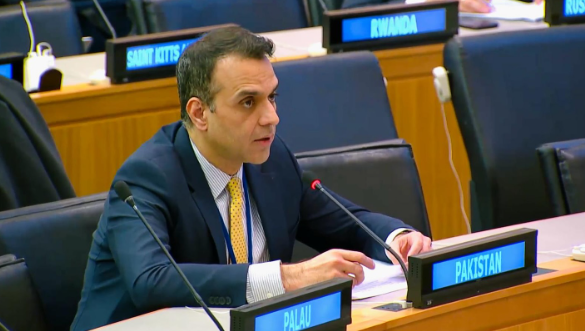
Addressing the Global Water Bankruptcy Policy Roundtable organized by Canada and the United Nations University on Tuesday, Pakistan’s UN Ambassador, Usman Jadoon, called India’s move a deliberate “weaponisation of water” and said it constitutes material breaches of the 1960 treaty.
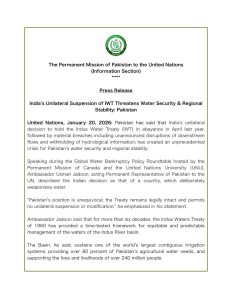
Ambassador Jadoon highlighted that since April 2025, India has carried out multiple violations, including unexpected disruptions of downstream water flows and withholding essential hydrological data, actions he said directly undermine the treaty’s legal framework.
“Pakistan’s position is clear: the treaty remains fully in force and cannot be unilaterally suspended or altered,” he stated.
The ambassador underscored that the Indus Waters Treaty has served for more than six decades as a reliable framework for equitable management of the Indus River basin, which supports one of the world’s largest contiguous irrigation systems. The basin provides over 80% of Pakistan’s agricultural water and sustains the livelihoods of more than 240 million people.
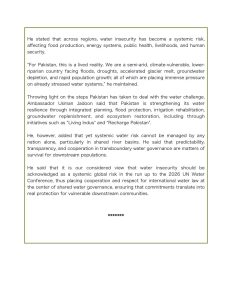
Ambassador Jadoon further warned that water insecurity has emerged globally as a systemic risk, affecting food production, energy, health, livelihoods, and human security. “For Pakistan, this is not theoretical—it is a daily reality,” he said, describing the country as a semi-arid, climate-vulnerable, lower-riparian state grappling with floods, droughts, melting glaciers, groundwater depletion, and population pressures, all of which intensify stress on already strained water resources.
To address these challenges, Pakistan is working to strengthen water resilience through measures such as integrated planning, flood protection, irrigation rehabilitation, groundwater recharge, and ecosystem restoration. National initiatives like ‘Living Indus’ and ‘Recharge Pakistan’ were cited as critical steps toward sustainable water management.
However, Ambassador Jadoon emphasized that shared river basins cannot be managed effectively by a single country, and called for predictability, transparency, and cooperation in transboundary water governance to safeguard downstream populations.
He concluded by urging that water insecurity be formally recognized as a global systemic risk ahead of the 2026 UN Water Conference, stressing that cooperation and adherence to international water law are vital to protect vulnerable communities.