
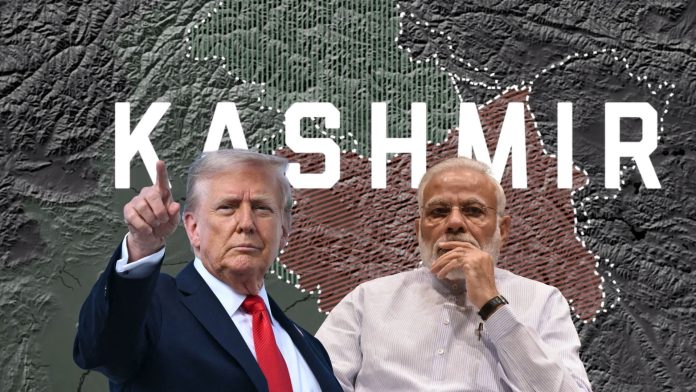

Despite receiving an invitation from former US President Donald Trump to join the newly proposed ‘Board of Peace’, India has not yet officially participated in the initiative. New Delhi’s absence was noticeable at the recent Davos ceremony, where 20 global leaders — including Trump and Pakistan’s Prime Minister Shehbaz Sharif — signed the board’s founding charter.
India’s reluctance is being viewed by analysts through the prism of the Kashmir dispute. There is concern in Indian policy circles that joining the board could invite increased international or American involvement in the long-standing territorial issue.
President Trump has stated that the primary objective of the Board of Peace is to turn the ceasefire between Israel and Hamas in Gaza into a permanent arrangement and to supervise an interim governing authority in the Palestinian territory. Speaking at the event, Trump said the initiative was intended not only for the United States but for the wider world, adding that similar peace efforts could be replicated elsewhere.
However, apprehensions remain in India that participation in the board — which Trump has portrayed as a potential alternative to the United Nations — could expose Indian-administered Kashmir to global scrutiny. Trump has repeatedly offered to mediate between India and Pakistan on Kashmir, particularly after the escalation between the two nuclear-armed neighbors in May 2025, proposals that New Delhi has consistently rejected.
According to a report by BBC Hindi, the Board of Peace is being established at a time when Washington is scaling back its engagement with several UN agencies, prompting questions about whether the initiative is intended to undermine the relevance of the United Nations. Critics also warn that the board could reinforce a US-centric global order.
An editorial published in The Hindu described Pakistan’s decision to join the board as a “warning sign” for India. The paper pointed to Trump’s tendency to position himself as a global peacemaker, noting his claims of resolving multiple international conflicts during his first year in office.
The editorial cautioned that if Trump were to include Kashmir in his peace agenda, the board could attempt to intervene. It further warned that once India joins, opposing the deployment of international peacekeeping forces could become increasingly difficult.
Former Indian ambassador to the United Nations, Syed Akbaruddin, wrote in The Times of India that a UN Security Council resolution has limited the board’s mandate to December 31, 2027, requiring it to submit progress reports every six months. This safeguard, he said, is meant to prevent the mechanism from becoming a permanent global institution. In contrast, Trump’s proposal lacks a defined time frame and could be extended beyond Gaza.
Akbaruddin also noted that some UN officials have suggested the framework could be applied to other conflict zones.
Meanwhile, former Indian ambassador Ranjit Roy, who previously served in Nepal and Vietnam, said India faces a difficult decision. Speaking to BBC Hindi, Roy argued that both accepting and rejecting the invitation carry consequences, but warned that joining the board poses significant risks.
He expressed skepticism over Trump’s leadership of the initiative, describing the former president’s approach as transactional and questioning whether all participating nations would be treated equally. Roy also pointed out that while the Security Council initially approved the board for Gaza alone, recent developments suggest its scope could expand.
The Hindu further suggested that ongoing trade negotiations and strains in US-India relations may be factors behind India’s cautious approach. According to the paper, outright rejection of Trump’s offer at this stage could provoke a negative response from the former US president, as seen in his past dealings with other world leaders.