
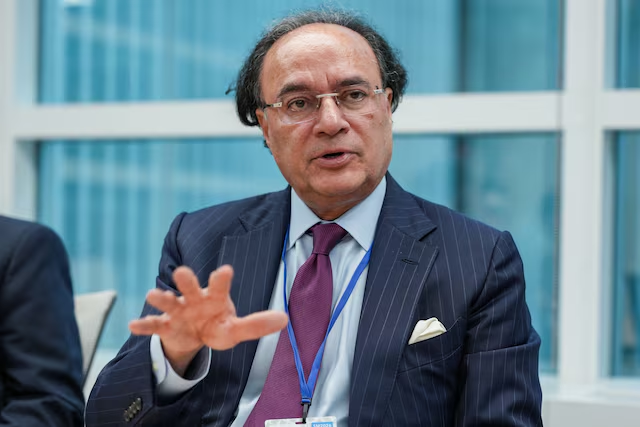

Pakistan is evaluating multiple financing avenues including Eurobonds, foreign loans, and commercial borrowing to replace a $3.5 billion facility from the United Arab Emirates (UAE) and stabilize its foreign exchange reserves, Finance Minister Muhammad Aurangzeb said.
Speaking to Reuters, Aurangzeb noted that the impact of the ongoing Middle East conflict has increased economic pressure, prompting Islamabad to reassess its energy and financial strategy, including the possibility of building strategic petroleum reserves and accelerating renewable energy adoption.
He said that “all available options are under consideration” when asked whether discussions were underway with Saudi Arabia for potential financing to substitute the UAE arrangement.
Pakistan is expected to repay the $3.5 billion UAE loan this month, a move that could temporarily strain foreign reserves and raise concerns over compliance with International Monetary Fund (IMF) programme benchmarks.
Despite the pressure, the finance minister said Pakistan remains capable of meeting its external obligations, with foreign reserves currently covering around 2.8 months of imports. Maintaining this level, he added, is crucial for macroeconomic stability.
Aurangzeb outlined that Pakistan is actively considering issuing Eurobonds, Islamic sukuk, and dollar-settled rupee-linked bonds, while also exploring commercial borrowing options. Eurobond issuance is expected later this year.
He also indicated that adjustments to Pakistan’s $7 billion IMF programme are not currently required, though changes could be discussed depending on evolving global conditions.
The IMF board is expected to approve the next tranche of funding—worth nearly $1.3 billion—by the end of this month or early next month under the Extended Fund Facility (EFF) and Resilience and Sustainability Facility (RSF).
In addition, Pakistan plans to launch its first-ever Panda bond next month, a yuan-denominated debt instrument, with a $250 million initial issue supported by the Asian Development Bank and the Asian Infrastructure Investment Bank as part of a broader $1 billion programme.
Aurangzeb said Pakistan’s projected economic growth of around 4%, strong remittance inflows of approximately $41.5 billion, and targeted social support measures are expected to help absorb external shocks this fiscal year ending June 30.
However, he warned that rising energy prices due to global instability highlight the need for strategic fuel reserves and a faster transition toward clean and renewable energy sources.
He emphasized that supply shocks like the current crisis reinforce the urgency of shifting away from reliance on volatile global fuel markets toward long-term energy resilience.