
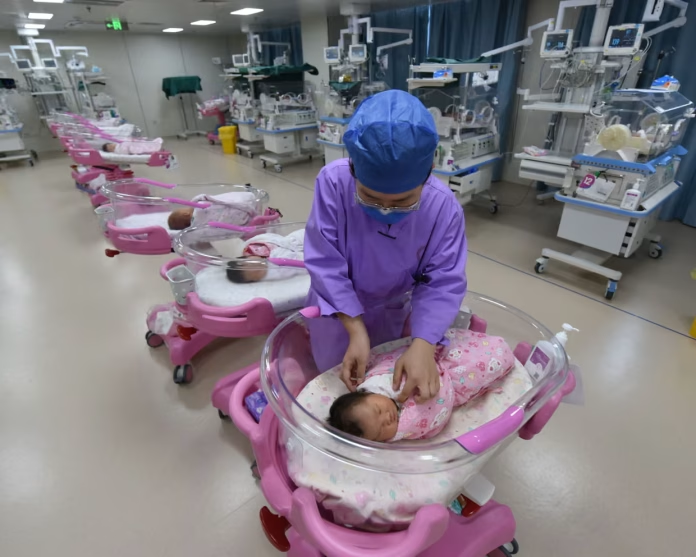

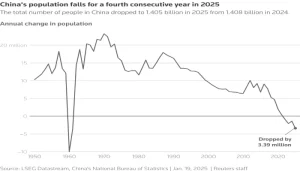
Mazaj News (Web News) China’s population declined for the fourth year in a row in 2025 as births fell to an all-time low, according to official figures released on Monday, prompting experts to caution that the downward trend is likely to persist.
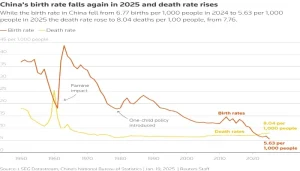
Data from the National Bureau of Statistics (NBS) showed that the population shrank by 3.39 million to 1.405 billion, marking a sharper contraction than in 2024. The number of newborns dropped 17% year-on-year to 7.92 million in 2025 from 9.54 million a year earlier, while deaths increased to 11.31 million from 10.93 million. As a result, the birth rate slid to 5.63 per 1,000 people.
Yi Fuxian, a demographer at the University of Wisconsin–Madison, noted that the number of births recorded in 2025 was “roughly comparable to levels seen in 1738,” when China’s population stood at just about 150 million.
Meanwhile, the death rate climbed to 8.04 per 1,000 people, the highest level since 1968.
China’s population has been contracting since 2022 and is ageing at a rapid pace, creating additional challenges for Beijing as it seeks to stimulate domestic consumption and manage rising debt levels.
According to the NBS, people aged 60 and above now account for around 23% of the total population. By 2035, the over-60 population is expected to reach 400 million—roughly equivalent to the combined populations of the United States and Italy—meaning a massive number of workers will exit the labour force at a time when pension systems are already under pressure. In response, China has raised retirement ages, with men now retiring at 63 instead of 60, and women at 58 rather than 55.
Lingering effects of the one-child policy
Marriage registrations plunged by nearly 20% in 2024, the steepest decline on record, with just over 6.1 million couples tying the knot compared with 7.68 million in 2023. Since marriage trends typically precede changes in birth rates, the drop has raised further concerns among demographers.
However, experts say a policy introduced in May 2025 allowing couples to marry anywhere in the country—rather than being restricted to their place of residence—could provide a short-term lift to birth numbers.
Marriage registrations rose 22.5% year-on-year to 1.61 million in the third quarter of 2025, putting China on track to potentially end nearly a decade of annual declines. Full-year marriage data for 2025 will be published later.
Authorities have also stepped up efforts to encourage what they describe as “positive attitudes toward marriage and childbearing” in a bid to counter the long-lasting social effects of the one-child policy, which was in place from 1980 to 2015. While the policy helped reduce poverty, it fundamentally altered family structures and demographic patterns.
Demographics central to economic planning
Internal migration has further intensified demographic pressures, as large numbers of people have moved from rural areas to cities, where the cost of raising children is significantly higher. China’s urbanisation rate reached 68% in 2025, up from around 43% in 2005.
Population policy has become a central pillar of China’s economic strategy. According to Reuters estimates, Beijing could face potential costs of about 180 billion yuan ($25.8 billion) this year to support higher birth rates.
Major expenditures include a nationwide child subsidy introduced last year and a commitment to ensure that women incur no out-of-pocket medical expenses during pregnancy from 2026 onward. All related healthcare costs, including in vitro fertilisation (IVF), will be fully covered by the national medical insurance system.
China currently has one of the world’s lowest fertility rates, at around one birth per woman—far below the replacement level of 2.1. Other East Asian economies, such as South Korea, Taiwan and Singapore, report similarly low fertility rates of roughly 1.1 births per woman.
The United Nations estimates that China’s population of women of reproductive age—defined as those between 15 and 49 years old—will shrink by more than two-thirds to fewer than 100 million by the end of the century.